REAL-TIME COPYRIGHT GOVERNANCE LAYER
Selective, pre-exposure control of rights-protected media within composite signal environments.
Modern media is no longer singular.
A single real-time output may contain voice, background audio, ambient environment, synthetic media, copyrighted music, broadcast content, and platform-generated signals.
Most enforcement systems still respond at the stream level.
They mute the entire output.
They block the entire stream.
They disrupt everything to control one protected component.
This creates unnecessary loss.
The Real-Time Copyright Governance Layer takes a different approach:
Identify the protected component. Isolate it. Govern only what needs control. Preserve everything else.
Nothing unnecessary is removed.
Nothing useful is lost.
EXECUTIVE CONTEXT
Real-time media systems now generate composite outputs that cannot always be fully verified before exposure.
That creates structural risk:
copyrighted media may reach users before detection,
full-stream disruption becomes the default response,
and enforcement decisions may be difficult to trace, justify, or defend after distribution.
This is not simply a moderation problem.
It is an infrastructure gap.
Systems generate layered outputs, but enforcement still treats those outputs as singular.
THE GAP
Modern media is layered, mixed, generated, captured, and distributed in real time.
Enforcement is often applied after exposure and at the full-stream level.
That means one protected component can cause the loss of an entire usable signal.
The result:
loss of usable content
disrupted user experience
reactive compliance workflows
limited traceability
unnecessary suppression of non-protected media
The gap is not detection alone.
The gap is component-level governance before exposure.
WHAT THIS SYSTEM DOES
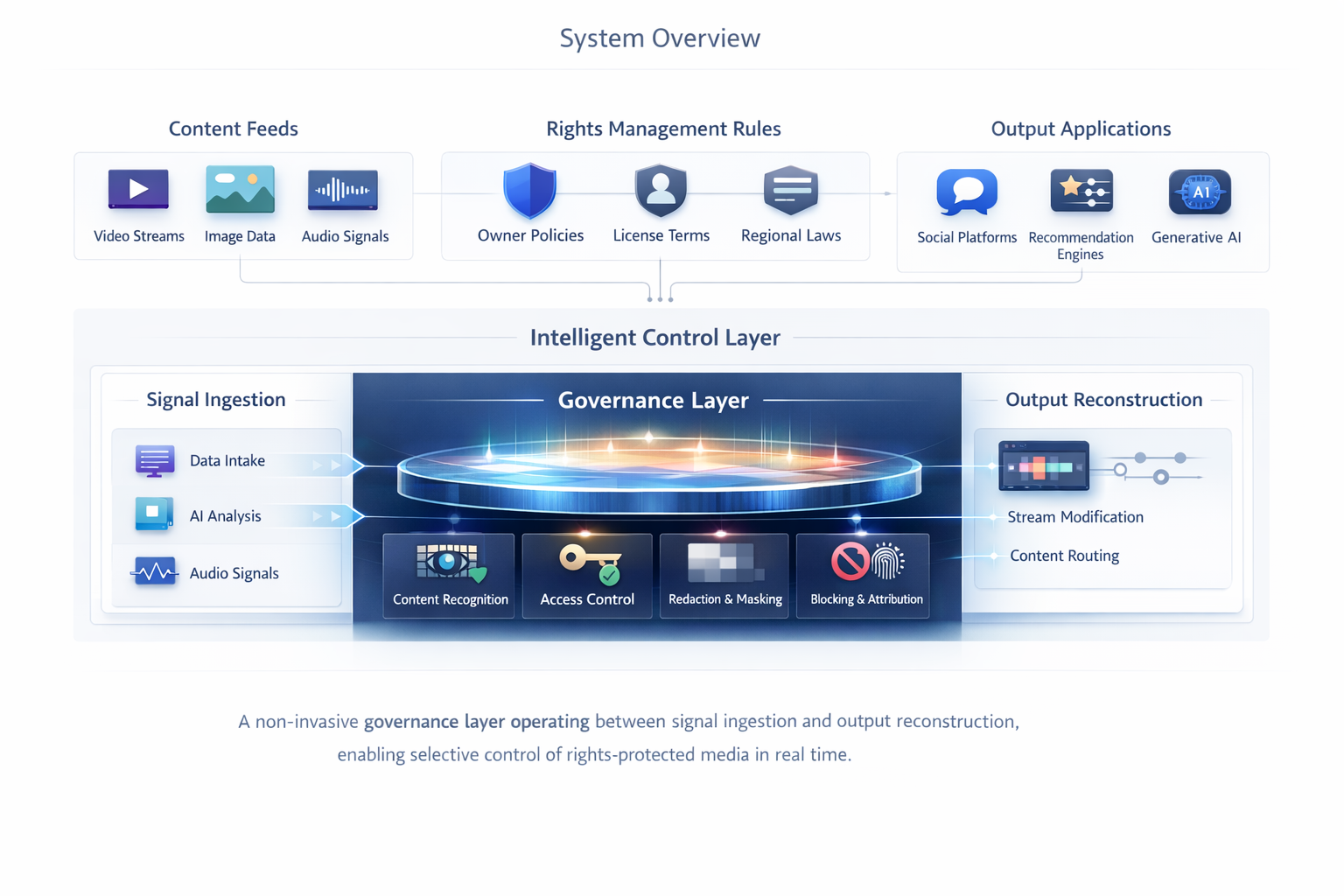
The Real-Time Copyright Governance Layer operates between signal ingestion and output exposure.
It identifies candidate rights-protected media inside a composite signal, isolates the relevant component, applies policy-based control, and reconstructs the usable output.
The system can selectively apply:
suppression
attenuation
masking
substitution
transformation
fallback replacement
full component removal when required
while preserving:
voice
environmental sound
non-protected media
timing
context
continuity
usable output quality
CORE PRINCIPLE
Rights-protected media should be governed at the component level before exposure — not at the stream level after exposure.
WHAT CHANGES
Instead of:
“Mute or block the entire stream.”
This system enables:
“Precisely govern only what needs to be controlled before it reaches users.”
SYSTEM ARCHITECTURE
The layer is composed of five functional modules.
1. Detection Engine
Identifies candidate rights-protected media across audio, visual, generated, and composite media environments.
2. Isolation Engine
Separates detected components from the broader signal.
3. Governance Decision Engine
Evaluates whether intervention is required based on confidence, context, identity, permissions, rights status, and policy.
4. Transformation Engine
Applies selective intervention to the protected component without unnecessarily suppressing the full output.
5. Reconstruction Engine
Reassembles the usable signal while preserving continuity, timing, and non-protected context.
DEPLOYMENT MODEL
The system can operate across:
device-level capture
edge processing
cloud orchestration
platform pipelines
streaming workflows
render-time output layers
Deployment may occur through:
API integration
SDK embedding
pipeline insertion
platform-level governance
edge or device-level processing
No system replacement is required.
Governance is introduced as an overlay.
OPERATIONAL STATES
The system can transition dynamically between governance states:
Pass-Through — no intervention required.
Selective Suppression — protected component is reduced, muted, masked, or controlled.
Transformation — protected media is modified, substituted, or replaced.
Full Component Suppression — protected component is removed while preserving remaining usable signal.
State transitions may be driven by:
confidence thresholds
rights status
contextual conditions
identity permissions
policy rules
platform requirements
latency constraints
WHY THIS MATTERS
In real-time content environments, risk does not begin when a violation is reviewed.
Risk begins when an unverified output reaches exposure.
This layer reduces that risk by introducing control before distribution, while avoiding unnecessary disruption of usable content.
It enables platforms to preserve experience while improving compliance posture.
STRATEGIC POSITIONING
This system does not replace content identification, moderation pipelines, rights management systems, or platform policy tools.
It extends them upstream.
It adds the missing control layer between detection and exposure.
PILOTS AND ADOPTION
Pilot deployments can evaluate the system inside real-world signal environments without transferring operational control or replacing existing infrastructure.
Pilot evaluation may include:
selective control accuracy
preservation of usable non-protected content
latency impact
false positive behavior
policy alignment
traceability of governance decisions
comparison of governed and non-governed outputs
The pilot is structured as an overlay.
Existing systems remain intact.
LICENSING AND COMMERCIAL ENGAGEMENT
The Real-Time Copyright Governance Layer is positioned as media governance infrastructure.
Potential engagement models include:
platform licensing
streaming pipeline integration
device and edge deployment
enterprise media governance
AI content pipeline governance
rights-aware distribution control
The layer is designed for organizations operating real-time media, streaming, capture, AI-assisted content, or composite signal environments where copyright exposure must be controlled before release.
CLOSING POSITION
Real-time media does not need full-stream disruption as the default response to protected content.
It needs selective governance.
Control the protected component. Preserve the usable signal. Govern before exposure.